

International photo reporters join forces to document Russian crimes
FRANCESCA MANCINI
|
19 November 2026
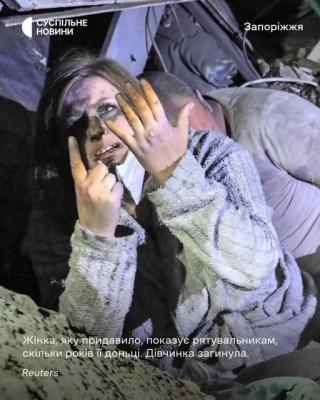
A woman trapped under the rubble after a Russian strike shows rescuers how old her missing daughter is
KYIV -- Unctuous American envoy Steve Witkoff may have praised Vladimir Putin as a "humanitarian," but two powerful images that appeared on front pages around the world recently underline how much he has swallowed Russian disinformation. In one a young mother, pulled alive from the rubble, held up her fingers to show the age of her daughter who just died under the bombs -- six years old. The Russian strike on her apartment building killed 23 people.
A few days later, beneath the rubble of another apartment building, the bodies of a mother and daughter are found still holding hands among another 17 dead civilians.
What are these images worth, destined to be lost in the vast digital sea? What purpose do they serve?
To discuss this with my photo reporter colleagues, I went to Kyiv. While Russian strikes kill people in universities, on trains, and in supermarkets, and Ukrainians wonder whether American satellites are still a viable option for saving people's lives, Kyiv, incredibly, continues to live.
The Ukrainian House of Photography and the Institut Français inaugurated Impact Kyiv, a forum bringing together international war photojournalists. Among the conference freebies is a metal torch, useful when the inevitable blackout hits.
"We didn't postpone the forum, we increased security measures," says Sasha Maslov, a Ukrainian photographer raised in New York who founded the forum. "This is the first event on war photography in a country at war. We want to be a home for those covering the conflict, a place to come together and think about the future. Because today it is hard to imagine anything positive for the future."
Opening the forum is Pierre Tequi of ECPAD, the French agency that manages the audiovisual archives of the French defence ministry and preserves over a century of conflict imagery. Because in Ukraine today, a central theme is "documenting the evidence"-- producing and archiving proof of Russian crimes and countering a narrative of History built for propaganda.
It is a challenge that also concerns the International Criminal Court and legal institutions, which are increasingly exposed to delegitimization by the American administration.
The production of this visual material relies first and foremost on the work of independent reporters on the ground, among them the veteran baroudeur, Patrick Chauvel.
A photojournalist since the Vietnam war where he worked at age 17, Chauvel, now 77, recounts his contribution to the Reporters Without Borders (RSF) investigation into the killing of Maks Levin, a Ukrainian reporter and his fixer who disappeared in March 2022. They had worked together in Donbas just a few weeks earlier.
Levin had been documenting the Russian occupation north of Kyiv with a drone, but its battery ran out on the return flight and the drone crashed near the front line. For two days, his partner would later recall, Levin was obsessed with recovering the footage, aware of how important those images were. He returned to the GPS location, but never came back -- on April 1, his body and that of Oleksiy Chernychenko were found near his car.
Evidence gathered by Chauvel shows that both were unarmed, without military equipment, and were murdered in cold blood by the Russians.
According to RSF, since the invasion, 175 journalists have suffered treatment amounting to war crimes at the hands of Russian forces in Ukraine; as many 16 have been killed. Among them was Antoni Lallican, a photojournalist killed by a Russian drone in Komyshuvakha, Donetsk, Oct. 3, 2025. During the forum, an exhibition featuring 13 of his photographs opened in front of the French Embassy. "All the cities and towns where Antoni worked are now occupied or destroyed by Russia," said his fiancée, Aida Beludid.
Yet documenting war crimes is also a responsibility of the state, Tequi noted, emphasizing the importance of training military personnel capable of producing reliable documentation.
Ukrainians have not lagged behind in this regard. The country's independent reporters are the most experienced in fieldwork, and on the front lines, every soldier in action wears a helmet-mounted camera. And it is here that one could say that the reporter stops being the one telling the story and becomes the story itself.
After months at the front, veteran Semen Kuchvara found himself reviewing footage shot by drones. He decided to create a work of dark sarcasm, pairing images of inscriptions written by soldiers on explosives before launch—such as "Dos tequilas por favor" or "Fuck this mothefucking casino"—with the raw reality of impact. From these sequences will come a book titled Pre Mortem. Semen writes: "For a soldier, humor and death live side by side. The former helps you endure and complete the mission; the latter reminds you of the price of every decision. Pre Mortem is a look from inside the war, where irony becomes a form of survival and a joke represents the last human gesture before the strike." It is hard to understand for anyone who has never spent more than a few hours at the front. Those images speak of becoming accustomed to war and the necessary cynicism of those who must choose every day between killing or being killed. And who, precisely for that reason, can afford a form of irony, however bitter. This is History.
Outside, reality moves fast: from Oct. 14 to 21 in Kyiv, nine more dead and attacks on energy infrastructure, residential buildings, a cardiology institute, a healthcare facility, and a metro station.
Beyond the threshold of an apartment in an old Tsarist-era building, however, time becomes eternal -- the "evidence" of the wars in Moldova, Azerbaijan, Armenia, Kyrgyzstan, Georgia, and Chechnya repeats itself. These are the images of Olexander Glyadyelov, who was born in Poland to Russian parents, growing up in Kyiv. His grandfather escaped Stalin's purges by hiding for years in Siberia; his father was a Soviet colonel.
How do you reconcile a son who chooses a Soviet military career with a father sentenced to death by the regime? It is hard to understand for anyone who never lived in the USSR, where you were part of the system and someone else decided for you.
"My father was an honest man. When the Soviet Union invaded Prague, he thought it was truly the end. Everything was wrong, he told me, but he only said so after the collapse. 'Why did you never tell me?' I asked him. 'Because I was worried about you, Sasha.'"
Olexander began photographing in 1989 with the independent collective Pohliad (Gaze), a group of photographers who wanted to tell stories outside the canons of Soviet propaganda.
In the hallway of what used to be his grandparents' home sits an enlarger; in the living room, packs of Tetenal photographic paper and black-and-white prints. Olexander still works exclusively with his Leica M6, a witness to 35 years of Ukrainian history.
"I didn't know when, but I was certain that a major war would come here too. I already thought so in the mid-1990s, after many trips to Russia," he says.
"Even back then, in the Russian Far East, where the major naval bases and nuclear submarines are located, local newspapers ran headlines like 'Banderites stab Sevastopol fishermen to death.' It was the propaganda preparing for war. Then I went to Grozny and understood how the Russians fight." In 1996, during the First Chechen War, Grozny was destroyed. "The streets were covered with the helmets of Russian soldiers sent to die. There had been no mercy."
On the morning of the full-scale invasion of Ukraine, Olexander packed four suitcases with his work and moved them to safety. "They belonged to the history of my country."
In the streets of the Podil neighborhood of the Ukrainian capital, explosions echo. Schoolchildren on their way to class stop inside the metro stations. Waiting for the air raid alert to end, everyone scrolls through social media feeds filled with thousands of images.
How do we distinguish truth from falsehood, how do we defend ourselves against artificial manipulation?
"Credibility is the true weapon against media mystification," says Chauvel—the same credibility visible in his images as they roll across a large screen, precious testimonies to half a century of history. Among them is a video of a young man immediately after a Russian bombardment. Everything around him is destroyed. The sound of the siren can be heard. Then he speaks:
"On our street, as far as I know, five people died, including two children. I'm sorry, I have so many emotions right now, because after this sound, just a little while ago, my wife died.”
“And I thought I had lost my whole family, but my two children, my father, and my mother are alive. I'm sorry for so many words, but I wish someone would listen to me, that the world would listen to Ukrainians. Help us."
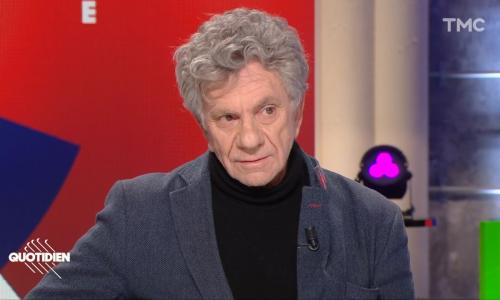
War photographer Patrique Chauvel
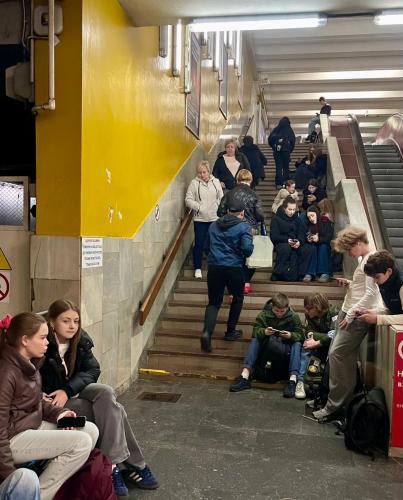
Residents in the Podil district of Kyiv take cover in the metro station as Ukrainian forces battle a Russian drone attack. PHOTO CREDIT: FRANCESCA MANCINI
© COPYRIGHT LVIV INSIDER
UNAUTHORISED REPRODUCTION FORBIDDEN