

Ukrainian Macbeth warns elite of 'dark future after victory’ over Russia
Bohumil Petrík
|
1 October 2026
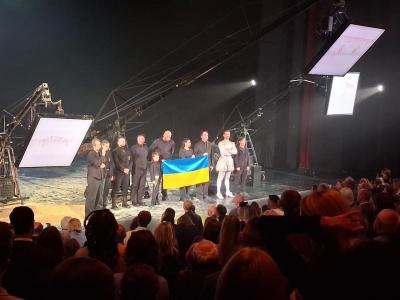
NITRA. Slovakia -- A version of Macbeth produced in war-torn Ukraine received tumultuous applause when performed at a festival hit by a funding crisis in neighboring Slovakia whose Government is considered less friendly than its EU partners. A warning about what might come after eventual victory over Russia was the main theme of the adaptation of the Shakespeare classic directed by famous Ukrainian theatre director Ivan Uryvskyi by the Ivan Franko National Academic Drama Theatre from Kyiv, critics said.
The play opened the Divadelná Nitra theatre festival in Slovakia, earned a standing ovation, the waving of the invaded nation's heroic flag by the actors, and chants of "Glory to Ukraine," markingthe 35th anniversary of both the country's independence from the Soviet Union and the Slovak festival's foundation.
The performance developed in dark black colours, costumes, props and tools. While in the original text written byShakespeare 420 years ago, Macbeth is addressed by three witches, in Uryvskyi’s adaptation, the womenare missing. One only hears voices behind the large, glowing screens mounted on long arms that move across the stage—even extending out over the audience—piercing the darkness with their light and speaking in a mysterious tone. They resemble cameras in a big TV room and their white screens starkly contrast with the surrounding black stage and figures. The protagonist is vulnerable and cannot escape them.
At the same time, they represent not only the witches, but are used as a table for a banquet hosted by Macbeth and his wife, and as a chair and a bed. The screens push Macbeth to act, circling around him as crows, blazing awhite glow which blinds him and underline the dark intentions and insistence of his wife which results in blockingnormal thinking and spreading unhealthy, morbidreflections to kill and kill more and more.
Yet their full potential arguably was not made use of. One could expect more light shows, special effects and artistic choreography. They fall short of being genuine protagonists, although they are definitely more than a mere instrument. Though the witches appear mainly at the beginning of the original Shakespeare’s text, prophecy and meet Macbeth again for a conversation before his death, they are only invoked a few times in the Ukrainian version of the play.
Going one step further, that is, turning the screens/camers into hags could releasetheir full potential and energy, but the director explained indiscussion with the publicthathe had another idea:
"Today, we are addressed via mobile phones, inundated with information and news without knowing where it originates or whether it is true. It is a reflection of information warfare, overload, and manipulation," Uryvskyi stressed, alluding to the ongoing conflict in his homeland.
Some said in 2025 when the play was released for the first time that it “has received glowing reviews, with audiences leaving the theater“ having “what they came for“ as it is “deeply resonant with Ukraine’s current reality.“ The Economist even wrote that “the production has since become the talk of the city’s elite.“
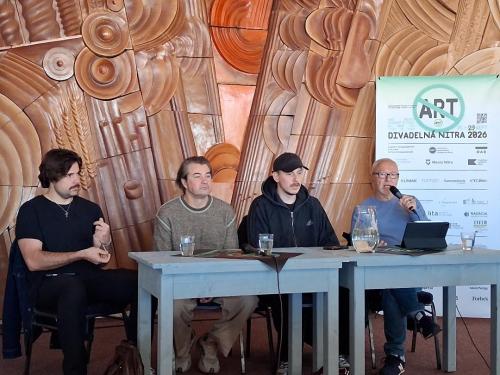
Beyond the stage and media frenzy, a few spectators expressed mixed feelings and confusion with the author of this review after the performance in Nitra. So did some artists and critics at the discussion with the creators the day after. Though theydid not deny the emotionally strong performance, but still struggled to find any serious link to the actual situation in the country and were surprised bythe considerable reduction of characters and scenes.
When asked, twice, about a missing deeper connection to the political and military situation of his homeland, Urinskyi saidthat he did not want the main protagonist to be easily "identifiable with someone in current Ukraine, Russia or elsewhere as we are travelling and performing the play outside of our country and showing it to soldiers and educated public" and each group has a slightly different understanding and reception.
"Once we performed Caligula and someone said: It is obviously Putin." It wasan understandable interpretation in a current context of war, the director acknowledged, but too simplisticsince "Caligula is so much more and cannot be read only via a contemporary political or societal lens."
Even against the backdrop of the "special military operation" in Ukraine, the director does not want to sell a cheap message of who is the enemy and rather delves into the mind of Macbeth, his doubts, fear, reflections, negotiation with his wife and eventually abuse and rise of power which he gained after a victory at the onset of the play.
The Ukrainian Macbeth was in fact more a warning about the country’s future after “victory,” the director of The Ivan Franko National Academic Drama Theatre in Kyiv Yevhen Nyshchuk said at the discussion with the audience:
"We have quite a few generals in the country who command significant authority, and in some cases, we cannot rule out political ambitions. We must be aware of what could happen after our victory, and we illustrate this in our artistic interpretation."
Though the performancetook place under the auspices of the Embassy of Ukraine to Slovakia, the City of Nitra and others, it faced the biggest financial crisis so far after it did not receive the state fund it usually relies on. Its jubilee 35th edition is called Future is Now! accompanied by crossed out "Art" on posters to suggest not only economic uncertainty as it refers to the current context of Ukraine and to what Ukrainian artists show in their performance of Macbeth.
The festival's organizers view the decision not to support them as “a threat to the values of artistic freedom, open dialogue and artistic quality.” The Fund for the Arts and the Ministry of Culture of Slovakia tries “to punish organizations and individuals for their artistic ambition, independence, and civic responsibility,” the Divadelná Nitra say, referring to the current situation in which various traditional artistic projects did not receive support, though some new and other ones did.
However, a Ukrainian Macbeth was able to come to "show how politics and power function,” Uryvskyi said.
jp-bp
© COPYRIGHT LVIV INSIDER
UNAUTHORISED REPRODUCTION FORBIDDEN