

Haunting documentary on wartime Kharkiv enchants Sole Luna Doc Film Festival
LARA LOTTI
|
16 July 2026
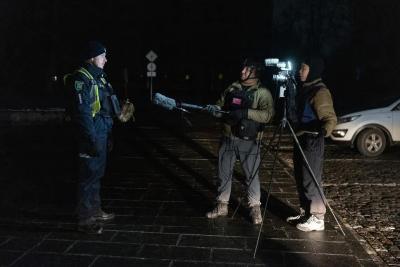
Megumi Lim and Marian Prysiazhniuk filming in Kharkiv
PALERMO, Sicily -- Night Shift, directed by Megumi Lim and Marian Prysiazhniuk, won the Best Short Film award at the 21st edition of the Sole Luna Doc Film Festival, an international event dedicated to documentary cinema,and stories that explore human rights, social change and intercultural dialogue. This year’s edition took place in Palermo, Italy, from July 6 to 12.
In 29 minutes, the documentary manages to condense the full complexity of war into an intimate and deeply human narrative. Far removed from the spectacular imagery of conflict, Night Shift observes thelives of those who carry on working and living whilst war constantly looms over the present, transforming night shifts and work in Kharkiv, Ukraine, into a powerful metaphor for waiting, fear and hope.
The international jury honoured the film for its ability to depict ‘the unsettling coexistence of ordinary gestures under the constant threat of violence.’ emphasising how the film succeeds in portraying the invisible weight of fear,and the way in which conflict ultimately creeps into the very fabric of everyday life. Dawn, which arrives after a seemingly endless night, thus becomes a symbol of hope for a different future.
The documentary’s effectiveness lies precisely in its narrative approach: it does not depict war through the deafening soundof weapons, but through silence, anticipation, small everyday gestures and the resilience of ordinary people. It offers an unadorned, rhetoric-free perspective that invites the viewer to reflect on the deeper effects of contemporary conflicts – those that slowly transform our perception of normality.
The award received at the Sole Luna Doc Film Festival confirms the value of a work capable of combining documentary rigour with cinematic sensitivity. Night Shift stands out for its sober and contemplative visual language, which leaves room for emotions and the evocative power of the images, entrusting time, silence and light with the task of recounting what often escapes the news reports.
"It’s my first short film," – said Megumi Lim in a thank-you message she sent from Kyiv to the festival after learning of the award – "I had no idea where this film would go or how it would resonate with other people. I’m really happy that it has now reached Italy."
"The reality depicted in this film continues to be the daily reality that people here in Ukraine live with. It hasn’t changed. Actually, in many cases, the situation has even worsened. I’m recording this message from Kyiv, where I live, and the attacks have increased here too. Full-scale war has been raging for more than four years. But my hope is that people will continue to support Ukraine and engage with what is happening here. And so I am delighted that my film can play even a small part in raising awareness about what is happening in Ukraine.’
With this award, the festival reaffirms its focus on documentary cinema that does not merely depict reality, but interprets it through an artistic and deeply human lens. Night Shiftis a significant example of how a short film can tackle universal themes with intensity and sensitivity, offering a reflection on the fragility of existence and humanity’s capacity to endure, even in the most difficult circumstances. A film destined to leave its mark on the international documentary scene.
This year’s Best Film – The Beauty of the Donkey by Dea Gjinovci (Switzerland, Kosovo, France, USA, 2025) – also deals indirectly with the effects of war. This hybrid, lyrical film follows Asllan’s return to Makermal, the Kosovar village where he was born, but where the idyllic world of his childhood has been wiped out by war. He is accompanied by his daughter, the director Dea Gjinovci. The jury praised the way in which individual memories become a journey of ‘collective healing’, returning dignity, hope, and even joy to a story deeply marked by trauma.
The 21st edition of the Sole Luna Doc Film Festival hosted over 40 screenings, talks, participatory workshops and film-related training, including a six-month training programme dedicated to documentary film projects that are currently being developed, designed to provide creative and production support to directors making their first or second film.
This project involves five of Italy’s leading documentary film festivals: the Sole Luna Doc Film Festival, the Bellaria Film Festival, Pordenone Doc, FrontDoc and the Festival dei Popoli.
jp

A children's hospital used also as a bomb shelter
© COPYRIGHT LVIV INSIDER
UNAUTHORISED REPRODUCTION FORBIDDEN