

Ukraine postcard: 48 hours in a country at war
Michael LaPointe
|
3 July 2026
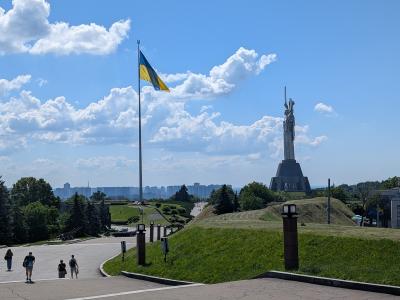
The Ukrainian Motherland Monument. Photo Credit: Mike LaPointe
KYIV-“Don’t head to the shelter when you hear the air raid alarm - go when you hear the first explosion,” advised Andriy, our taxi driver in Kyiv. Parts of a drone interceptor landed 10 meters from his taxi when he was waiting at the train station a few weeks back.
After check-in, I was on the phone with my wife, Gillian, in my room explaining that it wasn’t that dangerous, when right on cue, the air raid alarm went off. The hotel announced the alarm over the PA system and sirens in the street sounded. I said not to worry, and that I would call her back. Deciding to take Andriy’s advice, I waited it out in my room.
I was in Ukraine to review a five-star hotel in Lviv and decided to extend the trip east. We wanted to be able to tell an accurate story about central Ukraine and interview some new contacts in Kyiv and Odessa.
Logistically, Kyiv is hard to get to. I purchased tickets for the one-day train from Lviv to Kyiv. When the train arrived, the conductor said the cars we bought tickets for didn’t show up. My lack of Ukrainian language skills did not help the situation.
Left with the suggestion to speak with someone at the ticket office and having to stay in Lviv another day, I suggested that we could pay for a ticket for the train that was in front of us. She said, “The train is full,” but for 40 euros, she gave us her own cabin, and we were off. After a long and bumpy ride broken up with a tea break, we finally arrived.
Except for the curfew, Kyiv seemed like a normal city in the center, with open restaurants and people dining on the sidewalk. We were able to enjoy a dinner of Chicken Kyiv at sidewalk café across from the Italian Embassy. This being said, the people were waiting for a massive retaliation strike from Russia after the latest Ukrainian drone attacks in Russia.
However, my view of a tranquil city is limited as I did not spend much time there. The following week Russia launched a massive missile attack on the capital killing 30 and injury 90 people. Also, a British Reuter news agency employee, Ryan Evans was killed by an Iskander missile strike on his hotel in Kramatorsk in 2024. Not sure if he was waiting for the first explosion.
The next day we visited the Ukrainian Motherland Monument and the National Museum of the history of Ukraine in the second world war. located in a large park just outside the center. We also found an outdoor yoga session taking place. Then another air raid alert sounding the outdoor alarm. Some Ukrainians moved into the shelter in the museum but the yoga participants didn’t stop.
There was a collection of burned-out tanks from the Russian invasion a few years ago in front of St Michaels Gold Domed Cathedral. The statues in the main squares were covered up, and there were drone and military advertisements. Other than that, I was relieved to see that the city looked pretty good.
Later that night, there were two other air raid alarms at one and four in the morning. Taking Andriy’s advice again, I tried to sleep. My colleague, Filipowicz, who has worked in war zones intermittently for the past 40 years, was more cautious and went to the shelter for every alarm. For the late-night alarms, he found people sleeping in the shelter in beds provided by the hotel.
The “Air Raid Alarm” app was extremely helpful and even displayed “May the Force be with you” when the alert was over. It provides a map of all of the regions and allows you to set up alerts for specific places you are visiting.
Seeing the memorials in front of St Michaels and Independence Square was heartbreaking. Seeing the walls of photos of all the young faces that were lost was emotional, especially as that Sunday was Father’s Day. There were many pictures of women as well.
Every morning at nine am, there is a minute of silence for the fallen. Everyone stands up out of respect as music is played throughout the city. The first time I witnessed it, I didn’t realize what was going on and was late to stand up.
The next day, we were off to Odesa on a six-hour bus. The roads were relatively empty as expected. Unfortunately, we arrived just before curfew and found ourselves rushing to the Mozart Hotel next to the beautiful historic Opera House.
The following day, an early morning run gave me a better perspective of the city. Passing through the heavy tree lined streets and next to some light armored vehicles patrolling a waterfront park, I was able to get a great view of the beach. There were a few people out training on the numerous outdoor gyms.
The beach seemed less crowed than you might expect in summer, and there were plenty of bomb shelters clearly marked. Most restaurants were open, along with all of the beach clubs. Unfortunately, the next day, a 26-year-old woman visiting from Kyiv was struck by drone interceptor debris and died at the same beach. The alarm had ended by mistake, when there was an explosion in the sky, and she and her boyfriend were immediately struck.
At sunset, we left on a bus headed to Moldova to catch a flight the next day back to Rome. It was heartbreaking to see a place I loved wrapped up in war they didn’t start. However, I was proud to see them not only surviving but fighting back and becoming a stronger and more resilient country.
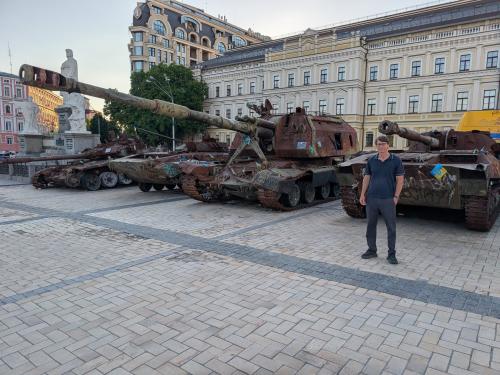
Standing in front of a collection of burned-out tanks from the Russian invasion a few years ago. Photo Credit: Mike LaPointe

The memorials in Independence Square. Photo Credit: Mike LaPointe
© COPYRIGHT LVIV INSIDER
UNAUTHORISED REPRODUCTION FORBIDDEN