

Ukrainian resistence stiffens in fortress Kharkiv
FRANCESCA MANCINI
|
4 June 2026

Children play in front of a bombed-out school in Kharkiv. PHOTO CREDIT: FRANCESCA MANCINII
KHARKIV – “I AM HERE,” bellows a man from the 9th floor of a swaying, 16-storey apartment block blackened by the smoke of explosions, that stands like a sentry in the desolate landscape of Ukraine’s defiant second city. In the north of Saltvika, an enormous Soviet style dormitory district some 30 km (20 miles) from the Russian border, the rumble of artillery is the constant background to continuous siren alarms that announce the sinister arrival of drones and missiles.
You have to come here to understand this is one of key cities of contemporary Ukraine, the largest after Kyiv, the capital. Kharkiv, Russophone until Ukrainian independence from Moscow, is a multi-cultural university city and an industrial and technological lynchpin. It’s the frontier city that more than any other shows how national identity does not depend on language, but on a deliberate civic, cultural and political choice.
When the city was the capital of Soviet Ukraine until 1934, it was from Kharkiv that the novelist and poet Mykola Khvylovy in the 1920s launched the slogan turn “Away from Moscow!” urging Ukrainian intellectuals to look instead to Europe, not Russia, for inspiration. That was the time of the “Executed Rennaissance,” the name given to a generation of modernist Ukrainian intellectuals most of whom were shot on orders of Stalin in the 1930s.
Bombarded heavily and continuously since the Russian invasion of Ukraine of 2022, but never conquered by Russian forces, Kharkiv is one of the cities that symbolises the indomitable spirit of Ukrainian resistance most poignantly.
In Saltvika, where before the war nearly 1 million people lived, the gray panorama of big industrial complexes is interrupted by the vivacious colours of revamped modern apartment blocks painted in red and yellow in different individual styles. The wall murals are symptomatic of a city that has been fighting since the Feb. 24, 2022, when the Russians approached it confident that they would find the “zhudny” – “those who stayed behind to wait” for the return of the Soviet Union. Instead they found men and women organized in many self-defence groups that continue to play their part.
At the time Borys was a young dance teacher who at age 18 had served in a bobm disposal unit. “The day the war started about 10 of us former comrades from national service got together and decided to put our know how to use. After a quick military refreshment course, we started work, especially laying mines.”
“When the Russians advances from North Saltivka, Tsyrkuny and so on we laid the mines, then when they retreated we had to remove the mines.”
Borys today belongs to a regular army unit clearing mines, working in areas 3 or 4 km from the front where accidents happen daily. “Working while the drones fly overhead you have to stay calm, otherwise the adrenaline strangles you,” he says. If an explosion happens nearby the group reorganises. The Russians leave huge minefields behind. Mines are everywhere, even in booby trapped washing machines and microwave ovens.”
“Even if the war were to end tomorrow it would take at least 10 or 15 years to de-mine the country,” he shrugs.
The atmosphere in Kharkiv changes according to which direction the drones and missiles are headed, as reported in Telegram channels. People constantly have their eyes on their phones.
Often the city is deserted and the few people you meet are walking fast, between the buildings that have been hit, with windows shattered or boarded up to replace the glass. Many shops and banks have closed and foreign retail outlets like McDonald’s, H&M, Zara and Ikea have remained closed since the Russian invasion.
Then suddenly it seems that people’s will to live overcomes everything and the city centre becomes crowded. For a few hours residents re-find a certain normality. The free metro underground trains and cafés fill up as the sun from the coming summer illuminates baroque and neo-classical buildings.
This is, however, a fragile normality, lived in a state of constant alert.
For cities like Kharkiv close to the border some short range or hypersonic Russian missiles are so fast they strike before the air raid sirens even sound.
That was the case on May 4, when a Russian ballistic missile believed to be an Iskander, hit Merefa, some 20 km from Kharkiv, crashing into a mundane street with no strategic or military value at 9:30 a.m. while people were going to work. Seven people were killed and 36 wounded.
On May 11, the mayor of Kharkiv, Ihor Terekhov, wrote on hisTelegram channel that during the week, despite a truce declared by Moscow, Kharkiv alone was battered by 20 attacks with Shahed and Molnya drones, FPV and missiles. As many as 71 air alarms were sounded during the week taking up a a total of 85 hours. As many as 21 people were wounded including six children. Civil and infrastructure buildings were hit – homes, businesses, petrol stations and essential services such as schools, electricity installations, sewage and communications plants.
“When you leave home you never know if you are going to come back,” Said Alona over a coffee she ordered before going to work. “One day a drone smashed into the bus stop at Saltivka where I normally wait,” she added, “I could have been among those who were killed there.”
“Here everyone has lost someone,” she said, gesturing toward the people in the bar. “Everybody has lost a friend or a relative killed during these four years of war.”
Often people become actively involved in the city defence when the war becomes personal for them. Organizations sprout up to obtain permits allowing their members to get permission to move about and help those in difficulty.
In the beginning the city lacked everything. Food, electricity, heating, all were scarse. It was cold and snowing. Since then ordinary citizen volunteers developed networks that have become a civil line of defence not just defending the city but saving people’s lives.
In the oblast of Donetsk and in Kramatorsk, in Sloviansk Pokrovsk, in the oblast of Kharkiv around Kupyansk, up to the hinterland just a few km from the front lines, volunteers manage evacuations of civilians at risk unable to escape on their own.
Then there are places under siege, now inaccessible, such as Kupyansk, where people can’t enter or leave. The head of the city’s military administration, Andrii Besedin, says 392 people are trapped inside of whom there is no trace.
It is in this extreme context that a reporter meets very different people who share in common the need to help and not to stand by without acting. Yervhen, aged 55, started by distributing bread produced in large quantities by an acquaintance for the Kulinichi bakeries. Today he co-ordinates an important part of the logistic network that supplies the army brigades fighting at the front.
Sasha, instead, is the son of a former Soviet army office and convinced Ukrainian patriot. Father and son decided to stay even though they could have left the country. Today the son is also an officer while his father travels hundreds of miles (km) to reach places where few people would like to go to evacuate as many people as possible.
Sasha founded the charity called Svit Ta Ukrayina (World and Ukraine), that receives support also from the Italian NGO Liberi Oltre, which thanks to the work of volunteers such as Andrea Alesiani, a humanitarian volunteer, collected funds and was able to donate an armoured vehicle for the rescue of civilians.
Italian volunteers sometimes take part in the evacuations. On this occasion they include Enrico Gippetto, 23, the youngest of the group, an expert in first aid and techniques of stopping bleeding from battle wounds, as well as being a climber expert in first responding and security at heights in big Italian industrial plants.
Enrico was driving the armoured car towards the village of Chevchenko, 325 km south of Kupyansk in the province of Kharkiv. Inside the vehicle the Chukya, a drone interceptor gives off an intermittent sound at high frequency that recalls a cardiograph monitor. When a drone approaches, the beeps increase, it seems like being inside an operating theatre. Then the tunnel of anti drone nets that cover thousands of kilometres of highway seem long strips of gauze wrapped around a town like a wounded body while the alarms are like human lamentations.
At the end of badly potholed country roads Sasha finds the small house, semi destroyed, where Mrs Natalia is hurriedly gathering her belongings. “For the past three months they’ve been bombarding this area day and night,” she says. She says goodbye to a neighbour with a hug that they know may be for ever.
Three years ago Natalia already was evacuated from Kupyansk after an explosion destroyed her house. A couple of friends also tried to flee the town but a drone attacked their car. The man ended up in hospital and his wife still is there, trapped in the siege of the town.
Without anywhere to go, Natalia is taken to a UNHCR reception centre. Tears fill her eyes as she gets out of the vehicle supported by Sasha, finally feeling protected.
An army of volunteers congregate in and around Kharkiv. All of them have lived through incredible adventures in the past years. They share a common vision of a fairer future, a sense of duty common to partisans of every age.
Olha, who lost a brother fighting in Bakhmut, helps young men wounded at the front returning from the battlefield.
With her is Danil Shustry, 28, a soldier of the Third Corps, 53rd Brigade, which is “the best” unit in the Ukrainian army, he says proudly.
“I am from the oblast of Donetsk, from Makivka, occupied since 2014 by the Russians. I haven’t betrayed my country. I went to serve my country and I want the occupied territories restored. I want everyone to survive, whether I know them or not.”
“I want mothers to be re-united with their sons again. My dream is to go to Crimea, a Ukrainian Crimea, to lie down on the beach and listen to the sound of the waves against the shore.”
This article first was published in Domani newspaper in Italian.
jp-fm
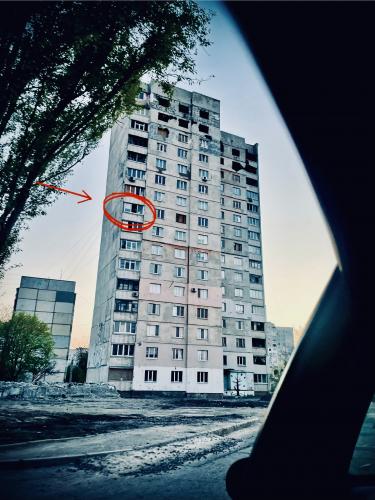
North Saltivka, the battered building where a defiant resident refuses to leave his home on the 9th floor. Photo credit: FRANCESCA MANCINI
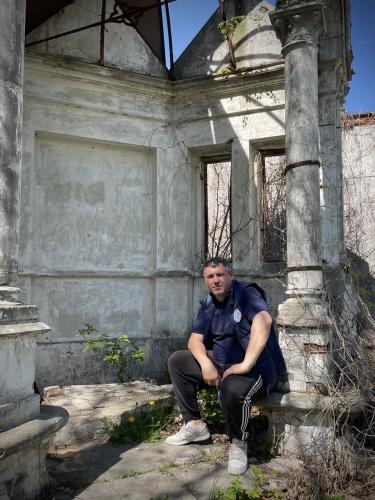
Sasha, founder of Svit Ta Ukrayina. Photo credit: Francesca Mancini
© COPYRIGHT LVIV INSIDER
UNAUTHORISED REPRODUCTION FORBIDDEN