

How one doctor's battle for language as resistance prepared Ukraine's medical profession for war
ValeriaKholostenko
|
26 May 2026
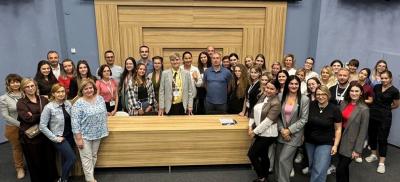
medical conference attendees in Ukraine gathered around UConn School of Medicine's Dr. Leo Wolansky inside the lecture hall at Lviv School of Medicine in 2024
This is a story about a man who understood something most people never think about -- A nation is not free until it heals in its own language. In 1991, Leo Wolansky and Dr Paul Capp founded Friends of Radiology in Ukraine at the Radiological Society of North America's annual meeting in Chicago, the largest medical imaging conference in the world, drawing more than 70,000 people every year. Leo was a neuroradiologist, an academic physician, and a native Ukrainian speaker who had grown up inside the Ukrainian diaspora in America, a community that had kept the language alive across generations, across an ocean, while the Soviet Union spent decades trying to kill it back home. The Union had just collapsed. Ukraine was free, for the first time in memory. What that freedom would actually mean in hospitals, in universities, in conference halls was still entirely unwritten.
Leo intended to have a hand in writing it.
The Soviet project in Ukraine had always been partly a language project. Russian was the language of authority, of education, of professional life. Ukrainian was tolerated in folk songs and rural kitchens, but serious people did serious work in Russian. Doctors were trained in Russian, published in Russian, lectured in Russian. To do otherwise was to mark yourself as provincial at best, suspicious at worst. Over generations this wasn't just policy, it became habit, internalized so deeply that many Ukrainians stopped noticing it at all.
When Leo traveled to Kyiv to speak at the Congress of Radiology, the most prominent medical imaging conference in the country, he noticed it immediately. The entire conference was conducted in Russian. The doctors in the room were Ukrainian. The country they were standing in was now independent. And yet the language of Soviet institutional life continued to run through every lecture, every presentation, every question from the floor, as naturally and unremarkably as water.
Leo delivered his lecture in Ukrainian.
It was not a neutral act. It was, in that room, at that moment in history, a declaration -- quiet, professional, delivered in the careful vocabulary of diagnostic imaging, but a declaration nonetheless. A free country's doctors could speak their own language. Someone had to go first.
He had been preparing for this longer than anyone knew. For years Leo had been working on a Ukrainian radiology dictionary, not a translation project but an act of construction, building standardized medical terminology in a language that had been deliberately starved of it. The Soviets had not simply suppressed Ukrainian in professional life. They had ensured it couldn't function there, by never allowing the vocabulary to develop. You cannot conduct a radiology conference in Ukrainian if the words for what radiologists do simply don't exist in Ukrainian. Leo was making the words.
This is the part of the story that tends to get overlooked when people focus on the equipment donations and the training programs. Before any of that could matter, the language had to be able to hold it. Leo understood this with a clarity that came from growing up in a diaspora community that had spent generations doing exactly the same thing — keeping a language functional, keeping it precise, keeping it alive.
At the time, language itself had become a political statement.
In 1996 he organized the first radiology conference in Lviv conducted entirely in Ukrainian. He brought nine American radiologists with him. The city of Lviv, in western Ukraine, had always been a stronghold of Ukrainian language and identity, but even there, medicine had been practiced and taught in Russian for as long as most of the attendees could remember.
The conference announced itself beyond Lviv. Leo was invited to work at the prestigious Lviv Institute. Radiologists traveled from across the country to attend. And word spread through the Ukrainian medical community that something different was happening in the west, that it was possible to do serious, rigorous, internationally connected medical education entirely in the native language of the country you live in.
The conference became a biennial event. Beginning in 1998, Leo co-chaired it with Yuri Ivaniv, head of postgraduate imaging education for the Lviv Oblast, and together they built something that would train thousands of Ukrainian physicians over the following decades. But the curriculum was always doing two things at once. On the surface it was teaching radiology, cutting-edge imaging techniques, neuroimaging, technologies that most Ukrainian hospitals wouldn't have access to for years. Underneath, it was insisting, conference by conference, year by year, that Ukrainian was a language capable of carrying all of it. That it was a language for science. A language for medicine. A language for Ukraine’s future.
The logic was straightforward, even if the execution wasn't. American radiology was twenty years ahead. Leo leveraged that gap deliberately. You want this new technology, this expertise, this access? Then we speak Ukrainian. This was not a small claim to make in the 1990s. It needed to be made repeatedly, in public, by people with credentials serious enough that dismissing them was difficult. Leo had the credentials. He kept making the claim.
By 2016 the conference had grown large enough to draw senior American radiologists from Yale, MD Anderson, and beyond, traveling to Lviv under the auspices of the ASNR International Outreach Program to lecture alongside their Ukrainian colleagues. Before anyone took the stage, every lecture slide had been translated into Ukrainian. The Americans showed up to a conference where the working language was not English, not Russian, but Ukrainian and that was simply the condition of participation.
Three years later came the moment that felt like a culmination.
In 2019, Tetyana Yalynska, president of the Congress of Radiology in Ukraine, invited Leo to Kyiv. Russia had seized Crimea in 2014 and was fighting a grinding war in the east, and the five years since had made something undeniable to most Ukrainians -- Moscow had never wanted a partnership with an independent Ukraine. It had wanted a subordinate one. The country's relationship with its own identity, its language, its institutions, and its professional life was shifting in ways that were visible everywhere, including in medicine.
The Congress of Radiology opened one week before Volodymyr Zelenskyy was elected president. The Ukrainian Minister of Health delivered the opening address. And the entire congress, the largest and most prominent radiology gathering in the country, the same conference Leo had sat in decades earlier listening to Ukrainian doctors present in Russian was conducted entirely in Ukrainian.
Many people credited Leo Wolansky for what had happened.
Then February 2022 arrived and rewrote everything.
Russia's full-scale invasion did not stop the conferences. It did not stop Leo from traveling to Ukraine, though most American doctors had long since stopped making the journey. The dangers were real. The logistics were punishing. The atmosphere in the lecture halls was nothing like it had been.
What had once been a gathering that drew radiologists from Donetsk, Kharkiv, Luhansk, and Crimea was now something different. Many of those colleagues were on the front lines. Some were dead.
Friends of Radiology in Ukraine moved toward the war rather than away from it.
Ukrainian radiologists kept training. They kept meeting. In September 2025, more than 1000 participants gathered in Kyiv for the 10th National Congress of Radiology in Ukraine, a program that now included medical imaging and diagnostics under active wartime conditions, a curriculum born from necessity. In March this year, the conference convened again in Lviv, with radiologists joining from Canada and Australia. The work continued.
The work continued. The 30th anniversary of the conference series drew more than 300 participants.
The Soviet project had a word for what it spent a century doing to Ukrainian professional life: русифікація. Russification. A softer word for erasure. The idea was that given enough time, enough pressure, enough institutional weight, Ukrainian would simply recede from the universities, from the hospitals, from the conference halls until it existed only in the places it had always been permitted -- in songs, in villages, in the past.
Leo Wolansky spent 30 years proving that wrong, one lecture at a time, in the precise and demanding vocabulary of diagnostic imaging. He started with the words because he understood that the words were the foundation. You could donate equipment. You could run training programmes. You could build exchanges and send American doctors across the ocean. But if the language those doctors were welcomed in was Russian, something essential remained unclaimed.
During his two terms as President of the Ukrainian Medical Association of North America (UMANA), Dr. Wolansky helped galvanize the Ukrainian medical diaspora across the United States. Through the foundation and national relief efforts, more than dlrs 20 million in medical equipment and humanitarian aid was shipped to Ukraine, over dlrs 2 million was raised directly, and four cargo planes filled with critical supplies were delivered to support hospitals and frontline medical care.
Dr. Wolansky had spent 30 years building the language, the conferences, the relationships, and the credibility that made all of it possible. When the full-scale invasion came, the infrastructure he had quietly constructed over decades became part of something larger than radiology. It became part of Ukraine's survival.
The words came first. Everything else followed.
Friends of Radiology in Ukraine: friendsofradiologyinukraine.org

A Ukrainian medic at work with a wounded soldier on the front line

Dr Wolansky at work
© COPYRIGHT LVIV INSIDER
UNAUTHORISED REPRODUCTION FORBIDDEN