

The Inner Game of Tennis: the classic guide to the mental side of peak performance: 50th anniversary edition
Michael Mewshaw
|
1 July 2024
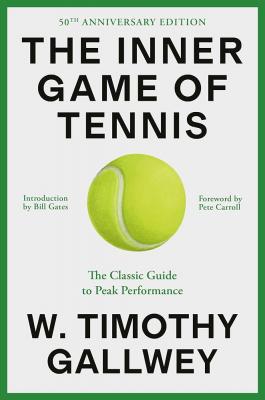
The Inner Game of Tennis
LONDON -- With 2024 Wimbledon about to start, it strikes me that I’ve spent almost a year of my life swanning around the hallowed grounds at SW19, London. It’s easy to do the math. I’ve had press credentials going all the way back to 1978. Allowing for a few years of absence, it still adds up to over 52 weeks of covering the fortnight. As Gore Vidal once answered when asked how he had come to spend 35 years of his life in Rome, I might claim it was just something I drifted into. But in fact there’s a series of events that clearly led me into a life on the sidelines of major tennis tournaments.
Decades ago, while on a Fulbright Fellowship, my wife and I huddled in a stone cottage in the south of France. It should have been heaven, but the house had no heat and was situated near a huge Provencal villa that provoked virulent envy. The villa’s owner, an Anglo-Irish expat, took mercy and loaned us a portable heater. Then he asked if I played tennis. I didn’t. Basketball was my game, scrappy competition in the atmosphere of honest sweat, not in starchy white shorts and the aura of country club cologne.
Still, my neighbour kept insisting and sweetened his invitation. He promised that if I practiced until I could give him a match, he’d let me use his court and swimming pool whenever I wanted. Then to clinch the deal he welcomed me to spend the summer on his seven-acre estate while he moved to his house in Dublin.
Although twenty-five years my senior, the guy looked fit and eager. For all I knew he might have been a former pro. But at the prospect of a rent-free life of luxury, Linda and I bought ten-dollar rackets with plastic strings and leatherette hand grips and began batting balls back and forth. The villa’s owner offered no instruction, not even the commonplace mantra, “Keep your eye on the ball! Bend your knees!” He did, however, give me a book, not a conventional how-to manual, more a Zen compendium of suggestions for accessing the tennis talent that resided within me. The Inner Game of Tennis, by W. Timothy Gallwey, sparkled with concepts that seemed to be as old as Emerson – that’s Ralph Waldo, not Roy Emerson. “Just do the thing and you will have the power.”
Lodged like a jewel in a copse of oleanders and cypress trees, the court was a perfect spot for beginners. Its gritty surface guaranteed a slow bounce that made every shot playable if you were ready to run. Loping around in my old Converse Allstars, I immediately loved the geometry and pace of tennis, and understood why so many writers were devoted to the sport. At the age of 30, it was much too late for me to master picture perfect groundstrokes. But The Inner Game of Tennis convinced me that didn’t matter as long as I got every ball back across the net. In tennis parlance, I became a “pusher,” a craven retriever, a devotee of dropshots and lobs. Too ignorant to apologize, I was soon the nightmare of more experienced players, the kind of guy who wins with pure, or impure, intuition. My neighbour never complained, but one defeated opponent shook my hand at the net, snarling, “You make a beautiful game very ugly.” Later a teaching pro took one glance at my strokes and suggested, “Take two weeks off, then quit the sport.”
Still, I kept faith with The Inner Game, convinced that I only needed to get out of my own way and allow my autodidactic game free rein. For the next fifty years, W. Timothy Gallwey freed me to ignore the strictures of classic instruction and simply play singles three times a week. This isn’t to claim that I ever achieved more than a 4.0 USTA rating. I was what the English called a “useful” club player. At my best I could occasionally beat – or at least take a set from – a former Division 1 college player. To celebrate my 65th birthday, I humbled a local teaching pro 6/1, 7/6 – all because he lost his patience and refused to respect my improvisations.
It delights me now to reread the 50th anniversary edition of The Inner Game of Tennis and reacquaint myself with the brain-teasing koans with which W. Timothy Gallwey shaped my unshapely game. Opening the book at any page, I rediscovered insights worth pondering. “The secret to winning lies in not trying too hard.” (p. 3) “All these skills are subsidiary to the master skill, without which nothing of value is ever achieved; the art of relaxed concentration.” (p. 10) “When we unlearn how to be judgmental, it’s possible to achieve spontaneous, focused play.” (p. 13) There’s “no right or wrong.” (p. 21) “Exercise no control; correct for no imagined bad habits. Simply trust your body to . . . toss the ball up, focus your attention on its seams, then let the serve serve itself.” (p. 32) “The less instruction interferes with the process of learning built into your very DNA, the more effective your progress is going to be.” (p. 35) “Once you learn how to learn you have only to discover what is worth learning.” (p. 50)
These words transport me back in time to that beautiful place in the south of France where without fully realizing it, I was changing my life. Learning tennis was only part of it. Playing the game not only allowed me to live for a handful of summers in a splendid villa, it forged a deep friendship with its owner. It also persuaded me to alternate the writing of fiction with non-fiction books about the gritty reality of life on the pro tennis tour.
In a Foreword, football coach Pete Carroll who won the national championship at both the collegiate and professional levels, writes, “Developing this skill of supreme trust and focus has always been the aim of the inner game and the aim of my coaching.” (P. VIII) Billionaire Bill Gates adds in an Introduction that W. Timothy Gallwey has influenced his management of Microsoft. By comparison, the impact of The Inner Game of Tennis on me may seem minor. But please indulge the happiness of a hacker who has for half a century owed W. Timothy Gallwey a debt of gratitude.
© COPYRIGHT LVIV INSIDER
UNAUTHORISED REPRODUCTION FORBIDDEN