

Women break the mould at Australian Open
Michael Mewshaw
|
22 January 2024
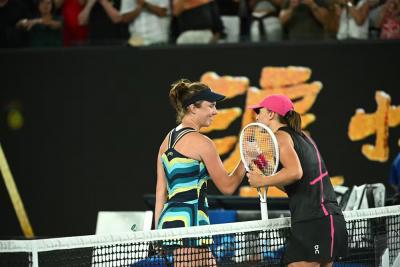
Linda Noskova shakes hands with Iga Swiatek
ROME -- The conventional chauvinistic wisdom holds that in Grand Slam tennis tournaments the opening round women’s matches aren’t worth watching. The gap—the Grand Canyon!—between top-ranked players and the rest of the pack is supposedly too great. At the current Australian Open, defending champion Aryna Sabalenka blitzed Lesia Tsurenko 6-0/6-0, prompting little surprise. But there were other results that did not run true to form in Oz.
In the first round, Naomi Osaka, the former Number One returning to the tour after a long absence, was briskly dismissed by Caroline Garcia of France. Given that Osaka was recovering from emotional problems, then a marriage, then the birth of a baby, the loss was at least explicable. Still other matches beggared belief. Ons Jabeur from Tunisia has in recent years twice competed for the Wimbledon title and has gained worldwide popularity as the sport’s first Arab star. But Mirra Andreeva, a sixteen-year-old Russian, stunned her and everybody else by brushing her aside 6-0/6-2.
When Andreeva stumbled into trouble against Frenchwoman Diane Parry, it seemed she had crashed back to earth with a deafening thud. Parry beat her 6-1 in the first set, only to have Andreeva bounce back and take the second set 6-1. In the third and deciding set, the yoyo score line continued as Parry sprinted to a 5-1 lead. It was then that Andreeva showed remarkable maturity for a raw adolescent. Instead of resigning herself to defeat or trying to blast her way back into the match, she changed tactics. She slowed the pace of her shots, just keeping the ball in play, prolonging the points, slicing and dicing her way into a tie-break which she won.
This was by no means the most amazing tie-break in the women’s draw. In the third round, Elena Rybakina figured to make short work of Anna Blinkova, a Russian ranked 57 in the world. Rybakina, who has been a fixture in the top ten since she won Wimbledon in 2022, was once also Russian but now competes for Kazakhstan, a port of convenience for players seeking support from the oil rich Silk Road nation. The odds still favored Rybakina when the match reached 6-6. The poker-faced Rybakina somehow managed to remain expressionless even as the players staggered through a 42-point tie-break, the longest in Grand Slam history. In the end, Blinkova won.
Amid all the craziness, Inside Tennis described Iga Swiatek, champion of four Grand Slam titles, as “a tiny island of sanity.” But the formidable Pole suffered what appeared to be a mental breakdown against Linda Noskova, an obscure Czech player from the even more obscure village of Bystricka, population 1,000. After easily taking the first set 6-3, Swiatek had no answers when Noskova started knocking off unreturnable shots from the baseline and serving clean winners that astounded spectators even more than they did Swiatek who lost the deciding set 6-4.
With only 3 top ten players still alive, the Australian Open looks likely to end in a showdown between Sabalenka or the 20-year-old American Coco Gauff. But only a madman would risk betting on a predictable final in Melbourne.
______________________________________________________________________________
Michael Mewshaw’s most recent book is My Man in Antibes: Getting to Know Graham Greene.
© COPYRIGHT LVIV INSIDER
UNAUTHORISED REPRODUCTION FORBIDDEN