

Roglič secures Giro d'Italia after stage 19 time trial showdown
MIKE DILIEN
|
28 May 2023
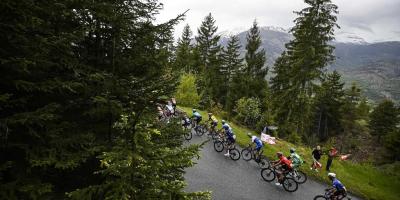
The breakaway of stage 14. Photo credit: Giro d’Italia/Facebook
ROME - Slovene rider Primož Roglič secured the overall victory of this year's edition of bicycle race Giro d'Italia after a thrilling time trial on Saturday. British veteran sprinter Marc Cavendish emerged victorious in the final stage of the competition, held on Sunday on the streets of Rome.
Following Saturday's intense time trial, which took place in the Alps, from Tarvisio to Monte Lussari, Roglič took the lead in the general classification, with Geraint Thomas from Britain trailing by 14 seconds in second place and João Almeida from Portugal in third place, 1 minute and 15 seconds behind Roglič. Although only 18.6 km long, this time trial had paralyzed the Giro since day one. Its 7.3 km-long climb was on raw concrete and had gradients up to 22%. The entire Giro had been designed towards this climax.
The event's organisation is known for its taste for innovation and experimentation. Anyone who saw the Giro in 2021 will remember Colombian Egan Bernal appearing from that dark tunnel and rushing past the two breakaway riders up the Campo Felice on a stretch of gravel.
This year, however, the time trial was a logistical nightmare: on the path of the Monte Lussari, cars could not follow their riders nor return to follow their next rider, and several stretches of the path were even too narrow for a cyclist to pass another.
The organisation imposed specific rules. Riders were not allowed to use a time trial bike on the climb. They either had to switch bikes in a designated area at the foot of the climb or use a normal bike throughout the entire stage. Cars would not be allowed on the climb: mechanics, with a bike fastened on their back, would take place on a motorcycle to follow their riders. The riders would be grouped into three tiers, each with about 40 riders. There would be a break of 45 minutes between each tier. In the first two tiers, each rider would start a minute after the other, while in the third tier, each rider would start three minutes after the other.
Apart from deciding whether or not to switch bikes at the foot of the climb, the teams had to make several technical decisions, particularly regarding the gearing that would best suit the brutally steep Monte Lussari. Several teams opted for gearing typical of mountain bikes.
The Tier 1 riders started at full speed on the traditional, flat part. However, on the climb, they then lost significant time. Dutch time trial champion Bauke Mollema was even passed by a rider who had started five minutes later.
The main battle, of course, would be between Primož Roglič and Geraint Thomas. Roglič would be the penultimate rider to ride this time trial, while Thomas would start three minutes later and be the last rider to start.
Although a specialist in this type of time trial and having become Olympic champion on a sloping track, Primož Roglič was facing several challenges. His main competitor, Thomas, had a lead of 26 seconds in the general classification. Therefore, to win this Giro, Roglič would have to ride the stage more than 26 seconds faster than Thomas, not an easy task given that Thomas is also a great time trialist and that throughout this Giro, he had proven to be in great shape.
Since Roglič crashed badly in two races last year, it seemed that his time trial skills were no longer what they used to be: from being an excellent time triallist, he had become a very good one. But most of all, Roglič once lost a Tour de France because of an uphill time trial which was scheduled on the penultimate day. The time trial to "La Planche des Belles Filles" would turn out to be a dramatic experience that has haunted him ever since.
Saturday afternoon, once both contenders had started, the stage became the "grand finale" the Giro organisation had hoped for. A true roller coaster!
At the first measurement point, located at the junction of the flat part and the climb, Roglič clocked a new record time. He crossed the measurement point four seconds faster than Portuguese João Almeida, third in the general classification. When Thomas crossed this point, he had lost two seconds to Roglič. Yet, as the earlier riders had shown, it was the climb that would be decisive.
On the climb, a crowd of Slovenian spectators - the finish line bordered Slovenia - cheered. Roglič pedalled his small gear smoothly. His rhythm was like a clockwork. Thomas, who had opted for a larger gear, seemed to be struggling. Thomas soon fell behind by eight seconds to Roglič. At the second measurement point, at 15.3 km, Thomas was already trailing by 16 seconds. With still 3.5 km to climb, his lead in the general classification had shrunk from 26 to 10 seconds. Roglič would surely win the stage and most likely the Giro.
But then, "o fortuna!", when riding over a pothole, the chain of Roglič's bike dropped. Roglič had to stop and swap his bike for another one. This manoeuvre would take at least 10 seconds! The mechanical mishap had ruined the climax the organisation had envisioned and it seemed Thomas would keep the pink jersey and win his first Giro. The memories of "La Planche des Belles Filles" came flooding back. Roglič, however, remained composed. He got off his bike, calmly put the chain back on, and jumped back on. In no time, he was pedalling his steady pace once again.
Yet, the manoeuvre had cost him 16 seconds. He could still win the stage, but it seemed difficult to win the Giro.
As the finish line approached, it became clear that Roglič's performance was outstanding. However, he still needed to be careful during the descent preceding the finish, which heightened the crowd's anticipation. Given his history as a daring former ski jumper, known for experiencing multiple crashes, this added an extra layer of excitement to the competition.
Everything went well for Roglič this time! He flawlessly navigated the final stretch, completing the race in an impressive time of 44 minutes and 23 seconds.
As Thomas descended towards the finish, it became evident that Roglič would not only win the stage but also the Giro. Thomas knew it, and so did the numerous Slovene supporters who cheered and waved the Slovene flag. At the finish line, Thomas lost 40 seconds to Roglič. The latter would take the pink jersey and, on the last day of the Giro, hold a 14-second lead in the general classification.
During the first rest day of this Giro, organizer Mauro Vegni had expressed his primary concern of bringing the race to Rome. While the event is often regarded as the most captivating among the three Grand Tours of cycling, this edition faced challenges due to COVID-19, adverse weather conditions, and numerous crashes. Over 50 of the original 176 riders did not reach Rome.
Seven stages concluded with a mass sprint, and more than half of the early breakaways resulted in a breakaway rider seizing the stage victory. Although the three mountain stages in the Dolomites failed to deliver the anticipated fireworks, the time trial exceeded all expectations. When people reminisce about this Giro, one image will endure: Roglič composedly fixing his bike's chain on a challenging climb of raw concrete, swiftly remounting and emerging triumphant in a demanding time trial that secured him the Giro d'Italia.
Final general classification of this year's edition:
1. Primož Roglič (SVN) Jumbo-Visma 85:29:02
2. Geraint Thomas (GBR) INEOS Grenadiers 0:14
3. João Almeida (PRT) UAE Team Emirates 1:15
4. Damiano Caruso (ITA) Bahrain – Victorious 4:40
5. Thibaut Pinot (FRA) Groupama – FDJ 5:43
6. Thymen Arensman (NLD) INEOS Grenadiers 6:05
7. Eddie Dunbar (IRL) Team Jayco AlUla 7:30
8. Andreas Leknessund (NOR) Team DSM 7:31
9. Lennard Kämna (DEU) BORA – hansgrohe 7:46
10. Laurens De Plus (BEL) INEOS Grenadiers 9:08
md/ms
© COPYRIGHT LVIV INSIDER
UNAUTHORISED REPRODUCTION FORBIDDEN